


Physics-Based Reduced-Order Models for the Digitalisation of Industrial Thermal Processes

Physics-Based Reduced-Order Models for the Digitalisation of Industrial Thermal Processes
The digitalisation of industrial thermal processes, from equipment design to operation, optimisation and predictive maintenance, remains a major challenge. This is not only due to the wide variety of processes involved — including heating, drying, evaporation, distillation, baking, melting, calcination, combustion, metal heat treatment and rotary kilns — but also because of their significant energy and environmental impact.
Industry is one of the largest energy-consuming sectors worldwide, accounting for approximately 37% of total final energy consumption globally and around 25% in the European Union. It is also responsible for 24% of global greenhouse gas emissions, and 21.4% in the EU. Around 74% of this industrial energy consumption is dedicated to thermal processes, with similar figures observed in Europe. Improving the design and operation of thermal equipment is therefore a key priority for reducing energy use, emissions and operating costs.
The challenge for OEMs
Original Equipment Manufacturers (OEMs) of thermal processes equipment typically rely on relatively simple design tools, such as empirical correlations, combined with their own accumulated engineering experience. Although this approach often leads to reasonable designs, the final solutions may still be far from optimal. In some cases, problems may arise when introducing design innovations or when equipment is installed in facilities for which the OEM has limited prior experience.
Advanced simulation techniques such as Computational Fluid Dynamics (CFD) can provide much deeper insight, but their application is not straightforward. Industrial thermal equipment often involves complex combinations of combustion, radiation, convection, heat transfer and chemical reactions. These phenomena take place in complex geometries, frequently at multiple scales, and in systems that may include more than one hundred tubes, requiring the simultaneous simulation of both the inside and outside of the tubes.
For many OEMs, using CFD internally requires specialised personnel, software licences and significant computational resources. Alternatively, outsourcing CFD studies to specialised companies can also be costly and time-consuming. As a result, both options are often difficult to integrate into the standard design workflow of SMEs and industrial equipment manufacturers.
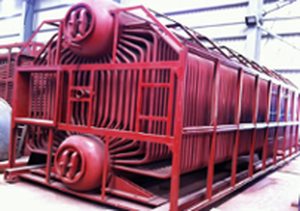
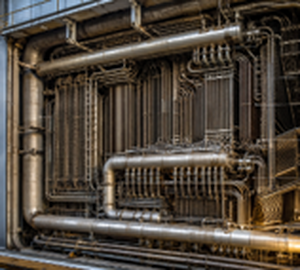
Industrial thermal equipment
The Fortissimo Plus approach: physics-based ROMs powered by HPC
Within Fortissimo Plus, nablaDot has explored an alternative route: the development of physics-based Reduced-Order Models (ROMs) using High-Performance Computing (HPC) resources.
These models are developed for a specific piece of equipment, taking into account the physical and chemical phenomena occurring inside it. The methodology considers the relevant design parameters and possible geometrical variations. Partial simulations, for example of specific components or regions of the equipment, are then carried out to generate datasets. These datasets are used to build correlations, functions or artificial intelligence models that characterise the behaviour of individual components and feed a global model of the complete equipment.
The final result is a model that runs close to real time while remaining grounded in the underlying physics of heat transfer and thermal processes. Because the model is physics-based, it is more robust, interpretable and extrapolable than a purely data-driven approach.
HPC resources are essential for this methodology. They make it possible to reduce the development time of a ROM from approximately seven months to around one month, making the commercialisation of this type of model much more feasible for industrial applications.
Key advantages of ROMs
Physics-based ROMs offer several important advantages for OEMs and industrial users:
● ROM results typically deviate by less than 10–15% from detailed CFD simulations. In the Fortissimo Plus experiment developed for a fired preheater, the deviation was below 4%, while the model executed almost in real time.
● ROMs reduce the design time dramatically. In one or two days, an OEM can analyse several alternative designs — a task that could take five to ten weeks using conventional CFD techniques.
● ROMs can also be integrated into existing workflows, for example as plug-and-play modules for Python, MATLAB or Excel. This makes them easier to adopt within engineering teams and existing design procedures.
● ROMs enable the creation of intuitive user interfaces that allow non-specialists to run high-fidelity simulations and explore design alternatives without requiring expert knowledge of CFD.
Additionally, the cost of generating the ROM can already be amortised (after designing only two or three pieces of equipment) when compared with a design process based entirely on CFD.
Beyond design, these models can be integrated into digital twins for applications such as equipment optimisation, advanced monitoring, predictive maintenance and operational decision support. This makes ROMs reusable assets and opens the door to new service-based business models for OEMs.
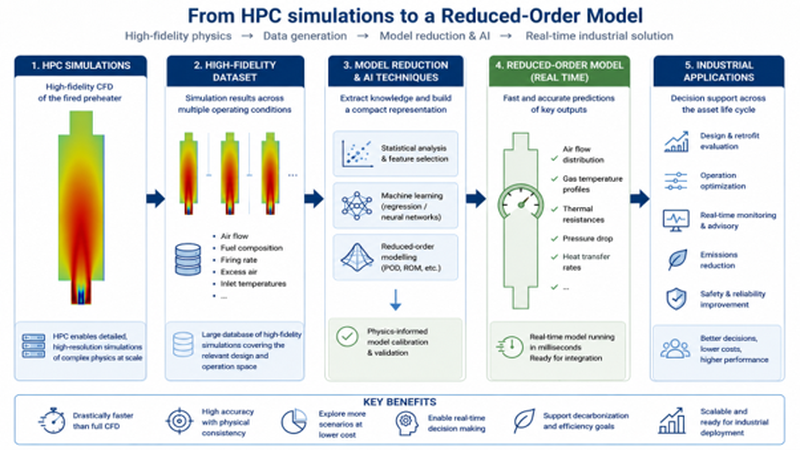
Building a ROM from HPC simulations
The Ignite experiment: Impact for industrial preheaters
In the Fortissimo Plus Ignite experiment, the participating OEM, Kalfrisa S.A.U., identified significant potential benefits from the ROM developed by nablaDot for its industrial fired preheater.
Thanks to the model, Kalfrisa expects to improve the efficiency of the industrial preheater by up to 30%. The ROM also strengthens the company’s ability to evaluate the use of greener fuels in its equipment, reduce CO₂ emissions by around 600 tonnes per year and achieve economic savings of approximately €120,000 per year.
The model also supports better design decisions with lower technical risk. It helps avoid equipment oversizing, reduces operational inefficiencies and provides a more reliable basis for innovation in thermal equipment.
Furthermore, the ROM enables Kalfrisa to explore a new digital twin service for thermal processes. Such services can contribute to thermal energy savings of around 10–35%, depending on the process, maintenance cost reductions of around 20–30%, CO₂ emissions reductions of around 15–25%, and reductions in unplanned downtime of around 20–40%.
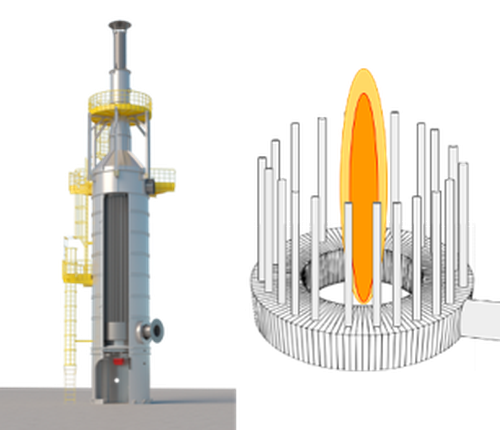
Fired industrial preheater
Strengthening European industrial competitiveness
This approach contributes directly to European industrial competitiveness by reducing energy costs, improving design quality and accelerating the digitalisation of industrial SMEs.
The target audience includes manufacturers and operators of fired heaters, preheaters, boilers, dryers, kilns and other industrial thermal equipment. For these companies, physics-based ROMs provide a practical bridge between high-fidelity simulation and day-to-day engineering decision-making.
Next steps: Towards scalable digital twins for thermal industrial systems
Further development will continue through follow-up initiatives such as iTWIN-TIS, Intelligent Platform for Rapid Deployment of Scalable Digital Twins in Thermal Industrial Systems. This project is funded by the Eureka Eurostars Programme and is expected to start on 1 October 2026, with a duration of 36 months.
Within iTWIN-TIS, a novel digital twin platform specifically designed for industrial thermal processes will be developed. The platform will address thermal performance across multiple process types and scales, enabling faster, more efficient and more cost-effective deployment of digital twins.
One of the key components of this platform will be a methodology for the automatic development of physics-based ROMs for thermal processes, building on the experience and results obtained through Fortissimo Plus.
Nabladot, S.L. is an innovative Spanish SME specialised in providing a comprehensive suite of digital solutions to support the design and operation of industrial processes, from simulation to digital twins, relying on techniques such as Computational Fluid Dynamics, physics-based Reduced Order Models, and Artificial Intelligence.
Author: Antonio Gómez, R&D manager Nabladot, S.L.