


Strong Demand for the FFplus Innovation Studies Call – 18 New Sub-projects Selected for Funding

The FFplus Innovation Studies (Type 2) support European SMEs and start-ups to further develop and customise advanced generative AI (“GenAI”) models. The SMEs are already highly proficient in generative AI, professional software development and data processing, but require access to large-scale European High-Performance Computing (HPC) resources to support their developments.
The new tranche of innvation studies selected through the 2nd open call will allow a set of SMEs to strengthen their technological and business potential by leveraging large-scale HPC resources for the development of innovative generative AI solutions. The selected studies will explore technologies including Large Language Models, multimodal AI, knowledge graphs and AI systems with advanced reasoning capabilities.
The indicative total funding budget for all sub-projects funded under this call was € 4M.
Statistics
Following the successful completion of the first tranche of 18 FFplus Innovation Studies, the second tranche has attracted exceptionally strong interest from European SMEs.
The call opened on 3 February 2026 and was designed to close once 250 proposals had been received or on 25 February 2026, whichever came first. The response was remarkable: 250 proposals were submitted within less than 24 hours, demonstrating the high level of interest in advancing generative AI through access to large-scale HPC resources.
The proposals involved 334 organisations from 33 European Countries. All eligible proposals were evaluated by external expert evaluators. The evaluation process determined which proposals best demonstrate the potential business impact of using large-scale HPC for the development and customisation of generative AI technologies.
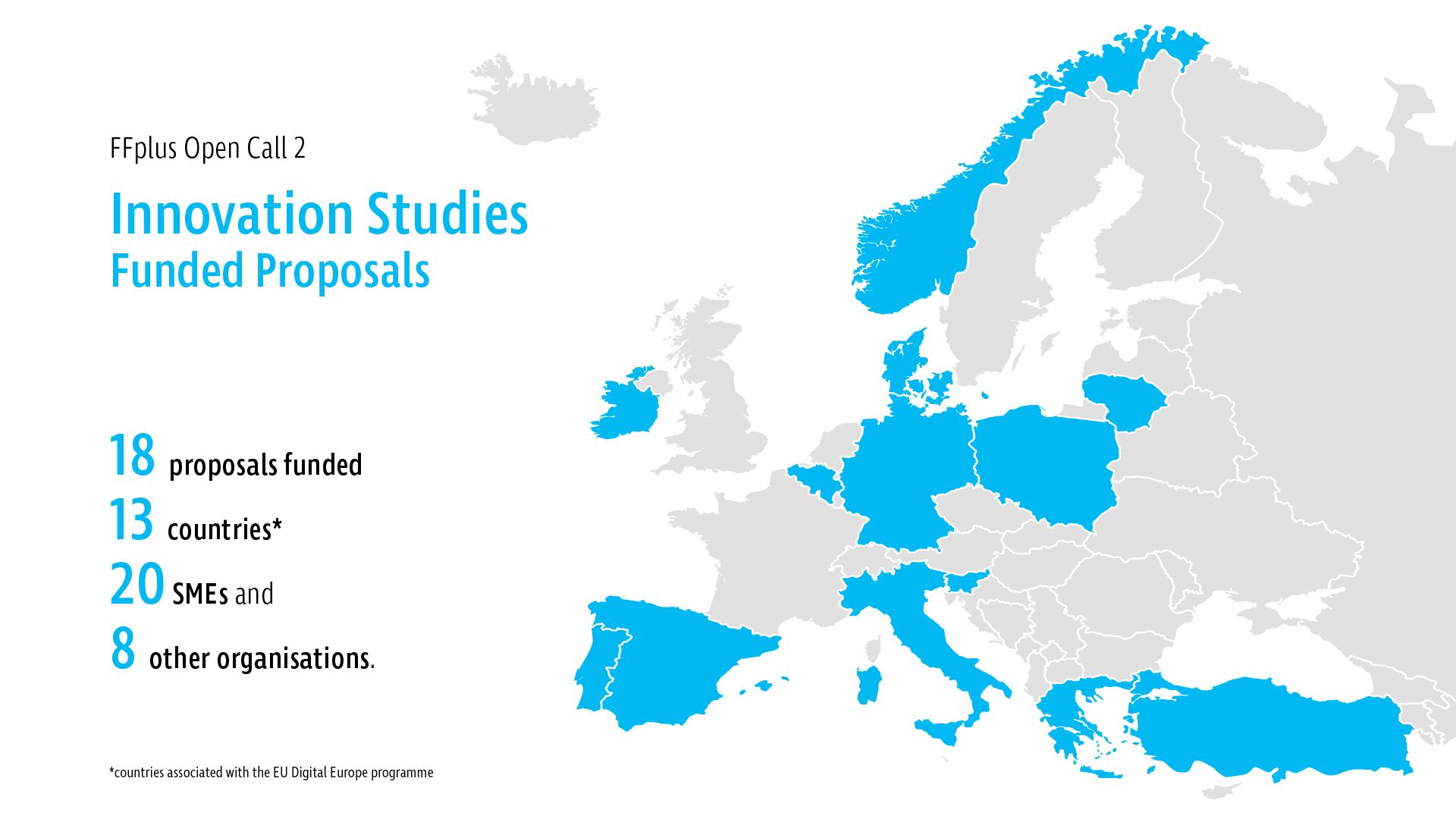
As a result of the evaluation, 18 Innovation Studies have been selected for funding, involving 28 organisations from 13 European countries.
The Innovation Studies are expected to start on 1st September 2026 and will run for a maximum of 10 months, with completion planned for June 2027. Each main partner SME can receive up to €200,000, with multi-partner consortia being eligible to receive up to €300,000 in total.
Country Statistics
The 18 selected Innovation Studies involve organisations from 13 European countries, demonstrating the geographical reach of the FFplus programme and its ability to support SMEs and start-ups across Europe.
The participating countries are: Belgium, Germany, Greece, Danemark, Ireland, Italy, Lithuania, Poland, Norway, Portugal, Slovenia and Türkiye, with Spain leading the field with five selected sub-projects.
In total, the 18 selected studies bring together 28 organisations, with 20 SMEs and start-ups at the centre of the proposed technological developments.
The geographical diversity of the selected projects reflects the FFplus objective of strengthening Europe's innovation ecosystem by enabling companies from different countries and sectors to access advanced HPC capabilities and develop new generative AI applications.
Application Domains
The selected Innovation Studies cover a broad range of application domains. It should be noted that several of the proposed technologies and products have potential applications across multiple sectors.
The selected studies address:
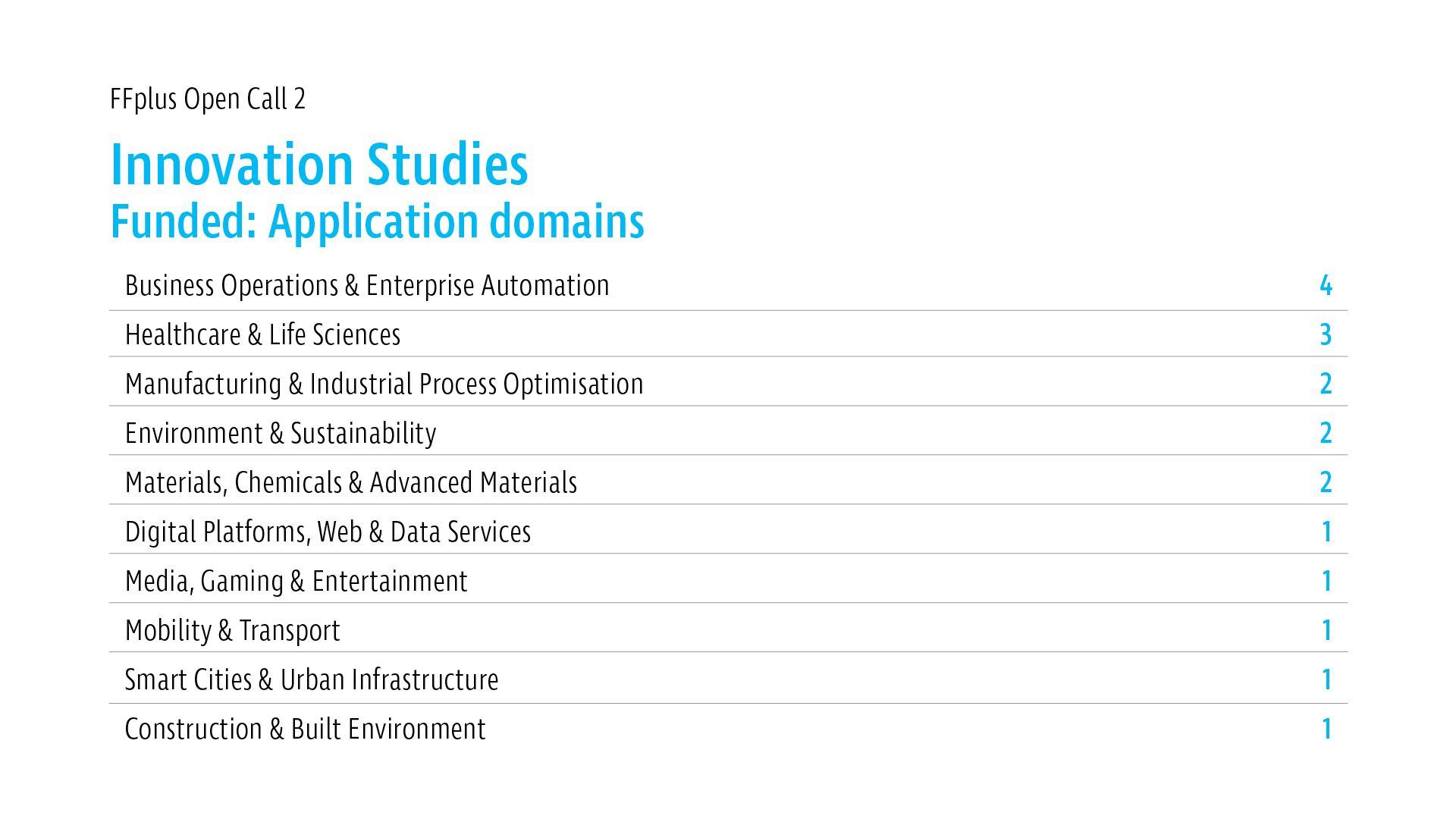
The diversity of application areas demonstrates how generative AI and HPC are becoming increasingly relevant across the economy, from healthcare and industrial processes to enterprise automation, sustainability and digital services.
Technologies
The technologies adopted across the 18 selected Innovation Studies are highly diverse, reflecting the rapid evolution of the generative AI landscape.
LLMs and other generative AI approaches feature prominently, with several projects incorporating knowledge graphs and reasoning capabilities to enable more advanced and context-aware applications.
Beyond text generation, multimodal AI is a key emerging trend among the selected studies. Several projects combine diverse modalities, including text, audio, images and video, to develop innovative generative AI solutions capable of processing and generating different types of content.
Pairing generative AI with reasoning capabilities is another notable feature, enabling solutions that move beyond generic content generation towards sophisticated analysis, decision support and domain-specific applications.
From HPC Resources to Business Innovation
The Innovation Studies aim not only to demonstrate technological feasibility, but also to establish clear business value and impact. Applicants were required to explain how access to large-scale HPC would enable them to address specific business challenges or opportunities, as well as define measurable objectives for their projects.
Over the coming 10-months period, the 18 selected SMEs and start-ups will develop and test their solutions primarily using European EuroHPCJU resources, supported by the FFplus project through technical consultation and assistance in accessing EuroHPC JU resources.
The results will provide new examples of how HPC and generative AI can accelerate innovation in European SMEs, with the successful developments ultimately becoming FFplus success stories that can inspire other companies to explore the potential of advanced computing and AI.
The next chapter of FFplus Innovation Studies is now beginning, bringing together European SMEs, generative AI and Europe's most powerful supercomputers to turn ambitious ideas into innovative solutions.
List of funded Innovation Studies sub-projects
Innovation Study Title |
Country of main partner SME |
| T-RMP: Typus integrating Real Material Manufactures | Germany |
|
TRACE (Transparent Research and Claim Evidence): Unlocking Flexible Knowledge Graphs Through Atomic Claims Architecture |
Portugal |
| SHIELD-GEN: Generative AI for Physics-Aware Barrier Optimization for Air Pollution and OdourMitigation | Spain |
| GDLM: Geospatial Data Language Model | Germany |
| FACEGEN-2: Photorealistic and Multimodal Craniofacial Reconstruction for Forensic Human Identification | Spain |
| GRAVITY-RAD: Grounded Generative Vision–Language Models for Radiology | Türkiye |
| Harmony 2.0: Accelerating structure-based epitope mapping via a hybrid AI model for de novo protein structure prediction integrating cryoEM data | Belgium |
| RELAY: Reliable Explicable Logic for Automated Yield | Italy |
| MAAT: Machine-Actionable ATC Radio Understanding with Generative Audio–Text Models | Ireland |
| FOML: Fine-tuning open models for best-in-class Lithuanian language correction | Lithuania |
| CYRUS-GenAI: Leveraging HPC and Diffusion-Based Generative AI for Scalable Industrial Surface Inspection | Greece |
| eBookAI: Schema-Bound Generative AI for Policy-Compliant e-Invoice Booking Proposals | Slovenia |
| SOV-CAT-VOICE: Sovereign Speech Foundation Models for High-Fidelity, Context- Aware & Controllable Catalan Speech | Spain |
| TENSOR-VID: Tensor-Optimized Generative Video for Efficient SME Workflows | Spain |
| GRAPH-RAM: Generative Recipes And Parametric HPC-simulation for Robotic Additive Manufacturing | Norway |
| TOPO-LLM: Topologically-Informed Large Language Models for Innovation Intelligence | Spain |
| SAFETLY: Secure Automatic Framework for blind ETL using sYnthetic datasets | Portugal |
| Gen‑cryoEM: Generative priors for data‑efficient 3D cryo‑EM reconstruction at large-scale HPC | Germany |