


AI-Driven Aircraft Flap Optimisation for Safer and Faster Flight

Organisations involved
BRM AERO is a Czech aircraft manufacturer and owner of the BRISTELL aircraft development programme.
AIRMOBIS is an aerospace engineering SME specialising in advanced aerodynamic design and optimisation services.
IT4Innovations at VSB–Technical University of Ostrava is the Czech national supercomputing centre, providing expertise in HPC, AI, data analytics and scientific computing.
The Challenge
Aircraft designers face a fundamental trade-off between low-speed flight safety and high-speed efficiency. Larger wings improve take-off, landing and stall characteristics, while smaller wings reduce drag, weight and fuel consumption during cruise flight.
BRM AERO wanted to improve the aerodynamic performance of its BR66 aircraft without compromising CS‑23 certification requirements, safety margins or handling characteristics required for pilot training and aerobatic operations. Conventional optimisation methods rely on repeated manual CFD analysis followed by mechanical redesign, limiting the number of design alternatives that can be evaluated.
Assessing thousands of flap and wing configurations using standard engineering workstations would have taken months and remained beyond practical computing capacity. To reduce development risk and identify the optimum design, an AI-assisted optimisation strategy was adopted. This required HPC resources capable of running thousands of high-fidelity CFD simulations and generating the large training datasets needed to build accurate surrogate AI models for rapid aerodynamic predictions.
The Solution
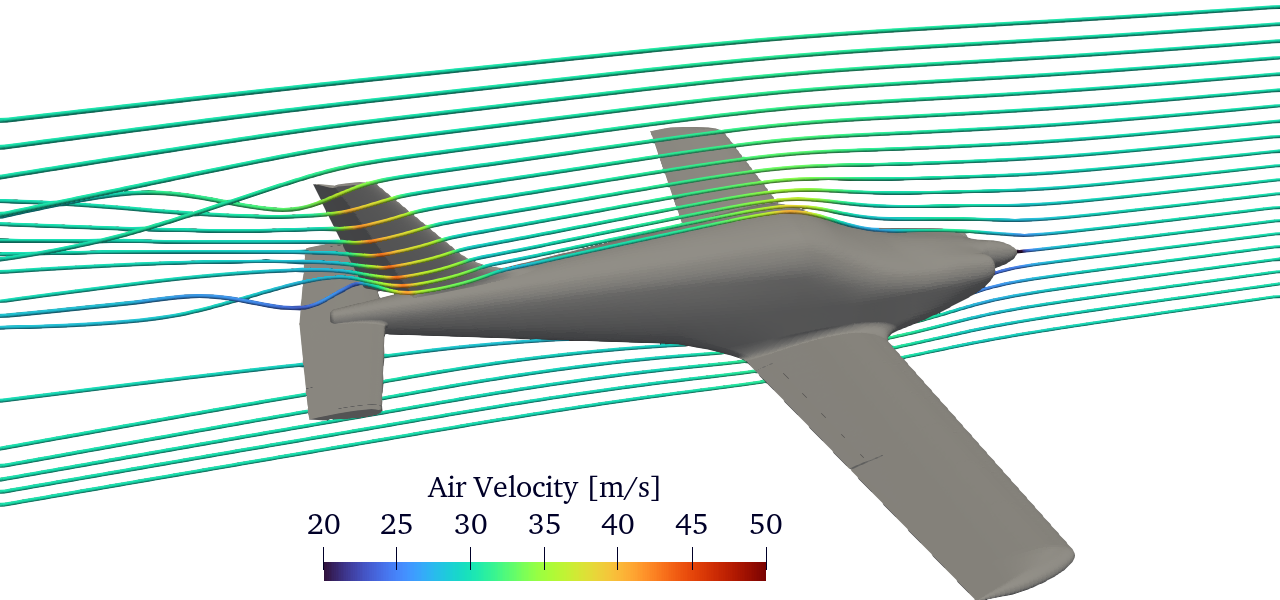
The consortium developed an HPC-enabled aerodynamic optimisation workflow combining CFD simulation, AI and machine learning. Thousands of virtual wind-tunnel simulations were executed on IT4 Innovations’ Karolina supercomputer, generating detailed aerodynamic data across a wide range of wing geometries. These datasets were used to train a surrogate model capable of predicting aerodynamic behaviour in seconds rather than requiring a full CFD calculation for each design. Promising configurations were automatically identified and validated using full-aircraft 3D CFD simulations.
The project delivered an optimised flap design for the BR66, a validated AI-driven engineering workflow and reusable design tools that can accelerate future aircraft development.
Business Impacts
The project confirms how HPC and AI can transform aircraft design by enabling large-scale aerodynamic optimisation that would otherwise be impractical. The BR66 achieved measurable performance gains, including a 13.7 kg reduction in structural mass, a 6.4% reduction in specific fuel consumption and an increase in cruise speed from 335 km/h to 351 km/h. These improvements lower operating costs for aircraft operators while improving efficiency.
Beyond the immediate product enhancements, BRM AERO now possesses a validated HPC-based optimisation methodology that can be reused across future aircraft programmes. Faster design cycles, reduced engineering risk and data-driven decision making will shorten time-to-market for future products. The business estimates that this methodolopgy could secure an additional 1% share of the European CS-23 market by enablingan increase in annual production by more than 40%. This could generate approximately €14 million in profit over five years.
Business Benefits
- Validated HPC and AI workflows enabling thousands of aerodynamic design evaluations, for subsequent reuse across future aircraft programmes.
- Aircraft structural mass reductions correspond to improved operating costs and performance, through greater fuel efficiency and cruising speed.
- Potential 40%+ increase in annual production creating an estimated €14 million profit over five years through strengthened competitiveness in 50+ export markets.