


Fixing Short-Term Energy Trading for Solar Power Generation
Organisations involved
alitiq GmbH is a German SME developing AI-powered forecasting and data-intelligence services for renewable energy markets. As End-User, it is commercialising improved solar-power forecasts for energy traders, virtual power plants and grid operators.
Validation Partners & Utilities is an energy trader, virtual power plant operator, and grid manager validating the operational and commercial impact.
Ventus Technologies GmbH provides meteorological services and modelling and weather-data processing at scale. It contributes the data and forecasting expertise to develop and evaluate the solution.
The Challenge
Europe's growing solar photovoltaic (PV) capacity is increasing short-term variability in electricity supply. Energy traders and grid operators must balance 96 quarter-hourly contracts daily, with the two-to-three-hour horizon being critical for continuation of trading until around 60 minutes before delivery. Frequent, location-specific forecasts can reduce this risk, yet traditional numerical weather prediction models do not reliably capture fast-changing, highly local cloud movements at such short lead times. Forecast errors create costly imbalance charges, increase curtailment and can trigger carbon-intensive backup generation.
This creates a business opportunity for alitiq, which provides AI-powered solar forecasts but relies on national weather-service data that lacks the precision needed for a competitive intraday product. Its own deep-learning nowcasting model must be trained and tested repeatedly against multi-terabyte satellite, radar and weather datasets. The data volume, memory demand and iteration rate exceed alitiq's in-house workstations. GPU-accelerated HPC is therefore essential to process the data, train alternative models quickly and support a service refreshed every 15 minutes.
The Solution
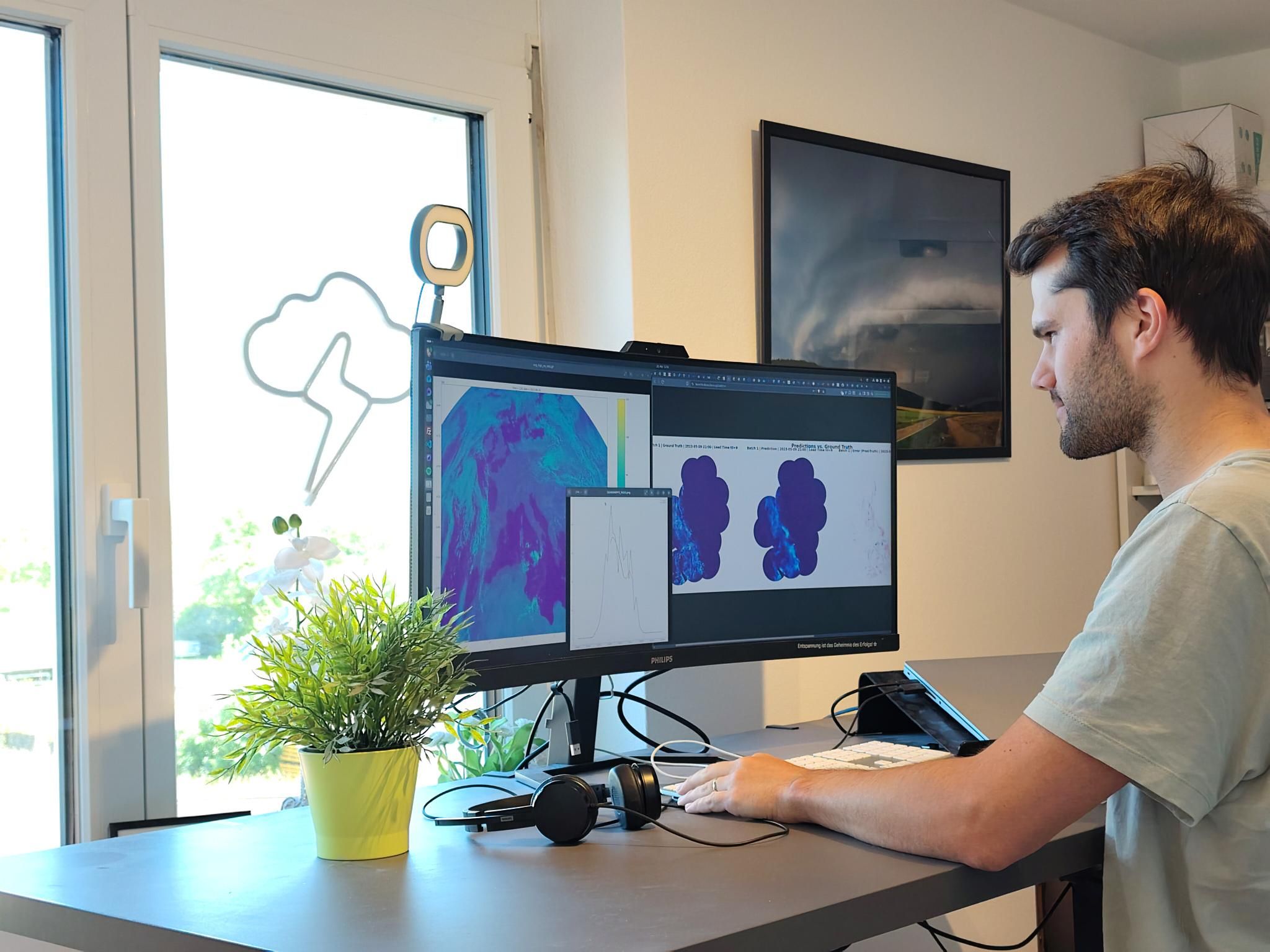
The project developed NowcastAI, an AI-powered pipeline that predicts near-term solar irradiance and converts it into electricity-output forecasts for PV installations. It combines live satellite, radar and weather data to track cloud movement, produces a six-hour outlook and refreshes every 15 minutes. Calibration reflects each site's equipment and characteristics.
The team prepared datasets in the Zarr format and trained neural networks on the EuroHPC JU Leonardo Booster supercomputer. More than 4,000 compute hours on its GPU infrastructure reduced a training cycle from 14 days on standard workstations to about 12 hours. This 28-fold acceleration enabled the team to compare model variants and refine the service within the experiment timeframe.
Business Impact
NowcastAI enables alitiq to extend its portfolio from day-ahead forecasting into a higher-value intraday service and perform more strongly in customer benchmarks. Without an accurate intraday product, alitiq currently wins four of every ten trials; with NowcastAI, it expects seven or eight, improving sales conversion and supporting growth. Validation with an energy trader, virtual power plant operator and grid manager supports market readiness.
Within 24 months, alitiq projects that the service could manage 2,500 MWp of solar capacity and generate €500,000 in annual recurring revenue, equivalent to the €200,000 development investment in about five months. For PV farm operators and energy-market traders managing a 1,000 MWp portfolio, a 10% reduction in forecast error could cut estimated annual imbalance costs of €2.75 million by around €275,000. Better forecasts can also reduce solar curtailment and reliance on fossil-fuel peaker plants, supporting a more efficient, lower-carbon grid.
Business Benefits
- 28x faster training: GPU-accelerated HPC cut a model-training cycle from 14 days to about 12 hours, enabling faster model comparison, testing and refinement.
- Higher sales conversion: alitiq expects its customer benchmark win rate to rise from 4 in 10 trials to 7-8 in 10 with the intraday service.
- €500,000 projected ARR: The service targets 2,500 MWp of managed solar capacity within 24 months of commercial launch.
- €275,000 potential annual saving: A 10% forecast-error reduction for a 1,000 MWp portfolio with €2.75 million imbalance costs.
- Skilled employment: Expected to secure two technical roles by 2028 and support five further operational roles by 2030.