


From Supercomputer to Surgeon's Desk - Safer Aortic Surgery in Under 5 Minutes
Organisations involved
LivGemini SRL is an Italian SME developing surgical planning software for cardiovascular procedures.
RBF Morph SRL provides mesh morphing for engineering simulation.
The University of Rennes and affiliated hospital surgeons contribute clinical, imaging and cardiovascular expertise.
INSA Lyon adds biomechanics know-how and experimental characterisation of vascular graft materials, helping connect engineering evidence with clinical practice.
The challenge
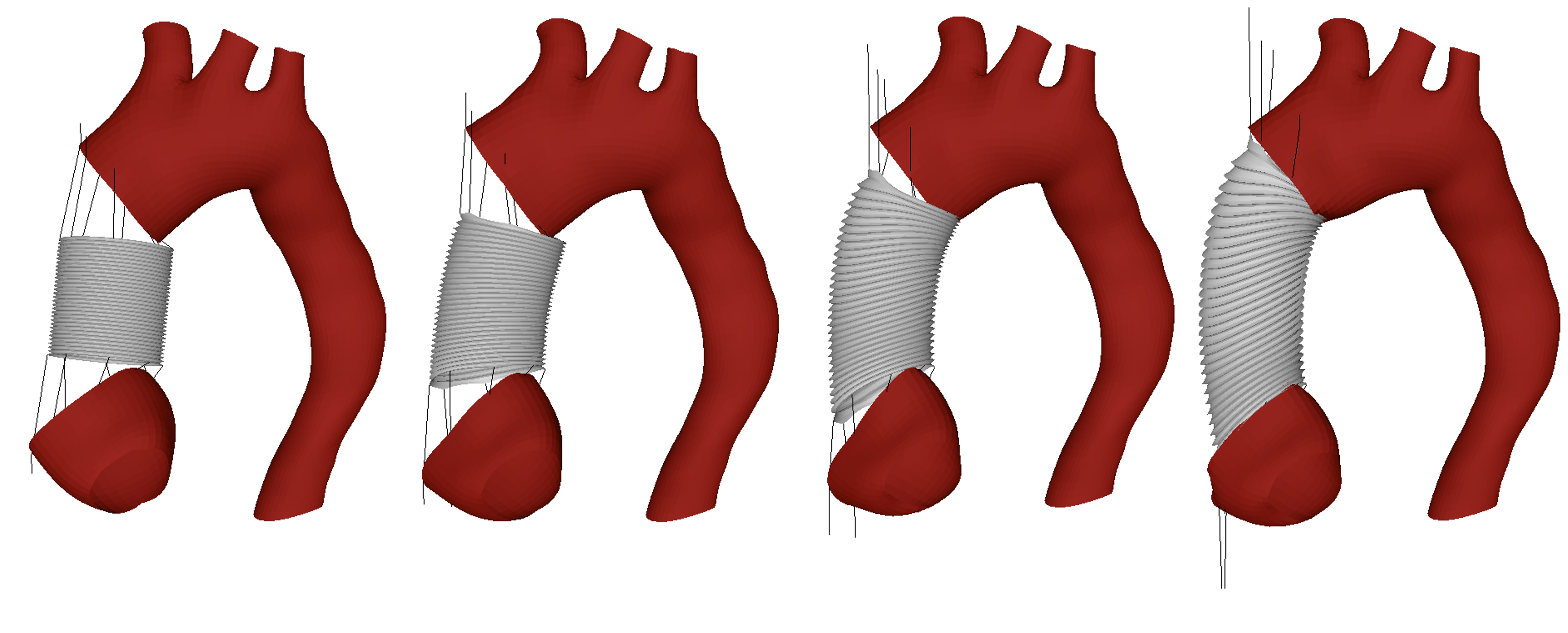
Aortic aneurysm-related deaths have increased by more than 81% in recent decades, and surgery remains the only effective treatment for advanced cases. Yet around 20% of vascular graft procedures require secondary intervention because prostheses are poorly adapted, compromised or incorrectly sized for the patient. Surgeons need rapid, reliable insight into how a specific graft will deform once sutured into a patient-specific aorta, but this capability is not yet accessible in routine planning. LivGemini's business bottleneck was therefore speed and scalability: high-fidelity biomechanical simulation could assess graft behaviour, size mismatch and post-suturing deformation, but one patient-specific analysis could take days on a workstation.
Creating enough cases to cover anatomical variability and graft options required many parallel finite-element simulations that only HPC could run at practical scale. Without HPC, the workflow was too slow, costly and complex for clinical use. PANDORA addresses this by using HPC to generate the evidence base for an AI surrogate model, enabling LivGemini to turn advanced in-silico analysis into fast, on-site surgical planning software.
The solution
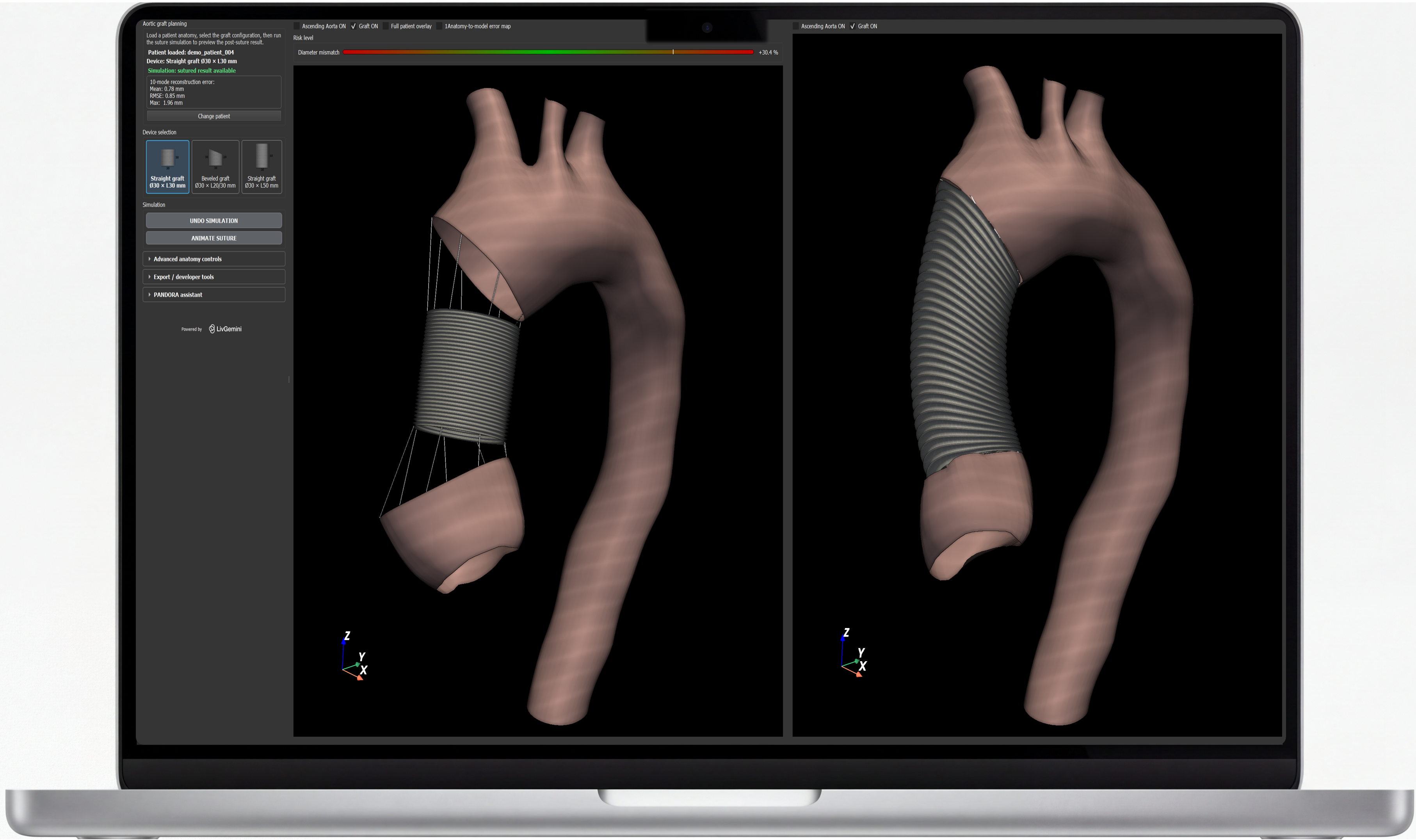
PANDORA developed an HPC-enabled workflow that combines medical imaging knowledge, finite-element simulation, AI and surrogate modelling. Using 900,000 core-hours on the Leonardo supercomputer, the partners generated a virtual population of 3D aortic anatomies and ran high-fidelity simulations of commercial vascular graft implantation in parallel. This HPC step produced the broad dataset that could not be created on standard workstations within clinically useful timescales. The results were compressed into a reduced-order surrogate model and integrated into LivGemini's software, enabling graft behaviour to be predicted in seconds rather than days. A classifier identifies unreliable configurations before execution, improving robustness for surgical planning.
Business impacts
PANDORA gives LivGemini a differentiated software asset for the digital health market: a secure, on-site tool that brings HPC-derived biomechanical prediction into surgical planning workflows. This strengthens the company's competitiveness by converting computational methods that were previously research-grade and slow into a practical clinical pathway into an estimated €8.8 million annual recurring revenue opportunity within four years.
For surgical teams, faster graft assessment can support more informed sizing, selection and traceability, helping clinicians compare options before operating, rather than relying only on generic device guidance. Subject to future clinical validation, better graft matching may reduce avoidable device-related complications, secondary interventions and associated hospital resource use. Each avoided aortic re-intervention is estimated to save €25,000-30,000 in repeat surgery, intensive care and extended hospital stays. The experiment also supports wider use of validated in-silico methods in medical-device development.
Business Benefits
- HPC and surrogate modelling reduces high-fidelity graft predictions from days to seconds, making them practical for clinical planning.
- Surgical planning time is reduced from 40-50 minutes to under 5 minutes, improving workflow efficiency.
- More precise graft sizing and selection mitigates the current 20% secondary intervention burden in aortic graft surgery.
- Each avoided aortic re-intervention is estimated to save €25,000–30,000 in reoperation, intensive care and extended hospital stay costs.
- LivGemini has a commercial software asset that could generate €8.8 million annual recurring revenue opportunity within four years.