


High Performance Centrifugal Compressor for Supercritical CO2
Organizations involved
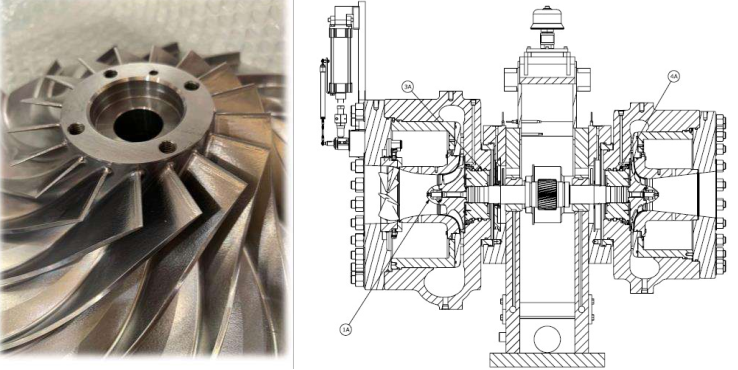
Compression Service Technology S.r.l. (CST) is an independent Italian engineering company with 50+ years of experience in rotating machinery. CST offers complete from-scratch centrifugal compressor design covering all required highly specialized calculations.
Ergon Research S.r.l. (ERG) is a University of Florence spin-off specialized in HPC-based simulation. With 35+ experts and a 1,000+ core cluster, ERG acts as Technology and HPC Expert with a proven track record in EuroHPC and Horizon Europe programs.
The challenge
The global push to decarbonize hard-to-abate industries such as steelmaking, cement and Oil & Gas, combined with the need to scale up Carbon Capture, Utilization and Storage (CCUS), is driving growing demand for supercritical CO2 (sCO2) compression systems over the next decade. CST had received repeated requests from OEM clients to design centrifugal compressors for sCO2 applications but had not yet been able to address these projects.
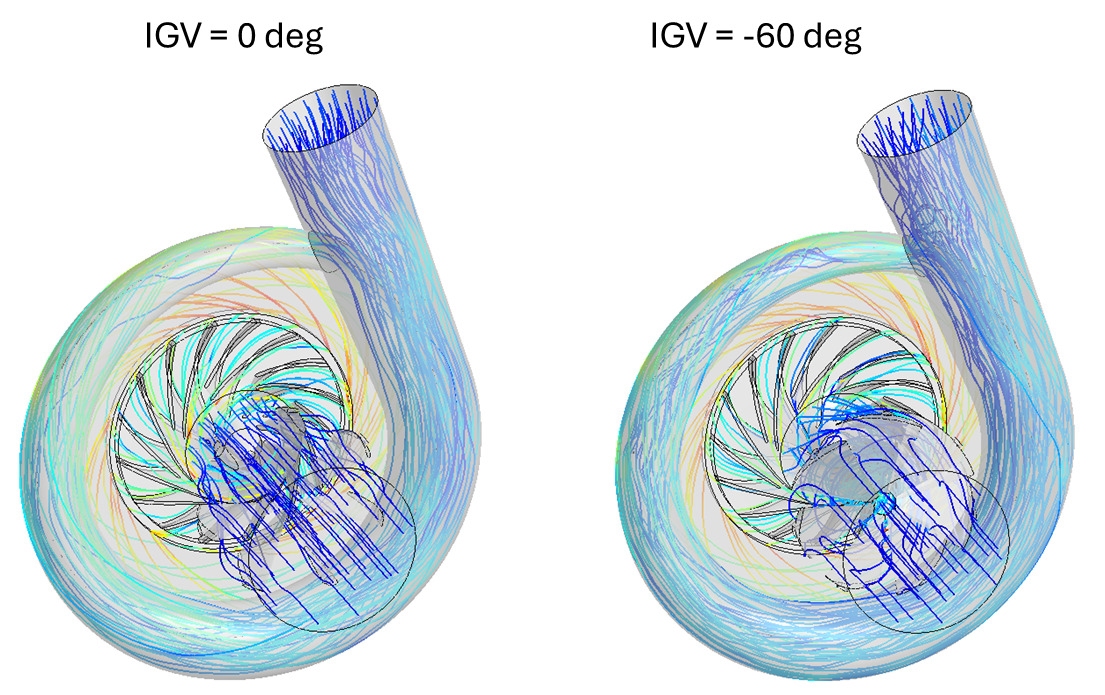
Near its critical point, sCO2 behaves very differently from conventional gases, making standard compressor design tools insufficiently accurate for reliable development. In the absence of physical prototypes or field data, high-fidelity computational fluid dynamics (CFD) simulation was the only viable path to a validated design. Given the need to evaluate multiple impeller geometries across several operating points, the computational load easily exceeds what standard workstations can handle, requiring access to a large-scale HPC supercomputer capable of running many simulations in parallel.
More broadly, the sCO2 turbomachinery market is currently served by a limited number of actors worldwide, leaving a gap between growing market demand and available engineering supply.
The solution
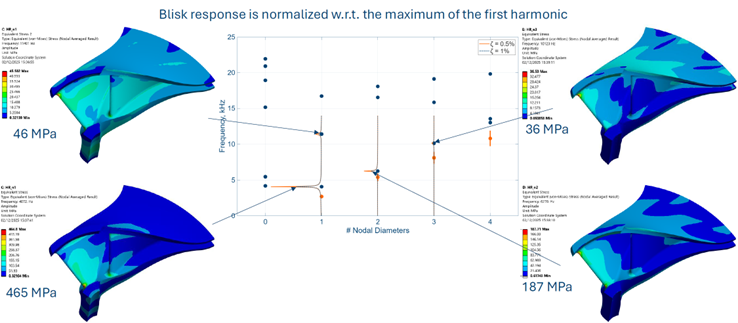
The project developed an advanced design solution for centrifugal compressors operating with supercritical CO₂, a fluid that is difficult to model accurately using conventional engineering methods. The solution combines three key steps: precise fluid modelling, aerodynamic performance analysis, and structural verification of compressor components. Using engineering software and real thermodynamic data from NIST, the team simulated how the compressor behaves under different operating conditions and verified that critical parts can safely operate at speeds of up to 23,000 rpm.
The Discoverer supercomputer was essential to perform these large-scale simulations. Models contained up to 100 million elements, requiring 10,000–30,000 CPU core hours per simulation, with calculations running on up to 1,024 processor cores. Without HPC, such analyses would have been impractical or prohibitively slow. The result is a validated compressor design and a reusable engineering workflow that can accelerate the development of future industrial compressor products.
Business impacts
The project delivers significant strategic impact for both consortium members and their customers.
For CST, it opens access to a market previously out of reach, establishing a validated engineering capability for sCO2 compression that contributes to filling a critical gap in European industrial supply. The reusable HPC methodology also extends to other non-conventional compression technologies, broadening CST's offering and strengthening Europe's engineering competitiveness in this emerging sector. Having a validated reference design strengthens CST's credibility with OEM clients, supporting long-term business development.
For ERG, the project validates a new commercial HPC service combining CFD and structural analysis, opening a new market segment with OEM clients and research institutions. For customers, access to a reliable sCO2 design service means shorter project timelines, reduced development costs, and access to a technology previously unavailable from European engineering firms — directly supporting CCUS deployment and EU 2030 decarbonization targets.
Business Benefits
- New market access for CST: first validated sCO2 centrifugal compressor design capability, enabling response to client requests previously declined.
- Revenue growth for CST: +1 M€/year from 2 design orders per year from end of 2027 (≈500 k€ each).
- Revenue growth for ERG: +650 k€/year from new OEM clients and expanded HPC-FEM services in research programs.
- Reusable HPC methodology: CFD + FEM workflow adaptable to different compressor sizes and fluids, reducing future design effort by 40–60%.